YITH WooCommerce Cost of Goods
$79.99 Original price was: $79.99.$4.99Current price is: $4.99.
YITH WooCommerce Cost of Goods is a WooCommerce extension that allows you to record the actual cost of each product and variation, automatically calculate margins, and make pricing decisions based on real data. Ideal for stores selling with extensive catalogs or tight margins, it relies on WooCommerce as its foundation and transforms the back office into an actionable profitability dashboard.
Introduction to YITH WooCommerce Cost of Goods
Managing a WooCommerce store without knowing the true cost of each product sold is like operating blind: revenue appears on the dashboard, but profitability remains hidden under layers of manual estimates and parallel spreadsheets, leading to errors, delays, and poorly informed pricing decisions. YITH WooCommerce Cost of Goods eliminates precisely that friction by integrating cost data directly into the order flow.
This add-on doesn't just store a number. It connects it to processed orders, product variations, sales reports, and back-office filters, so cost becomes a dynamic variable within the operation, not a static figure that needs to be manually cross-referenced each month. The administrative burden is reduced, and traceability by order or SKU becomes instantaneous.
Imagine an e-commerce manager reviewing the weekly order report in WooCommerce: with this module active, each order line displays the gross margin calculated in real time. No need to export to Excel, no need to cross-reference data with the supplier. It detects in seconds which product is eating into the margin and adjusts prices before the problem escalates.
Product overview
Cost management is one of the operational pillars that has the greatest impact on the viability of a growing WooCommerce store: without visibility into real margins per product, any pricing, promotion, or restocking decision is based on assumptions that sooner or later generate undetected losses, especially when the catalog exceeds a few dozen items.
Before implementing this tool, the typical scenario involved exporting orders to spreadsheets, cross-referencing SKUs with supplier cost lists, manually calculating margins, and often discovering that a discount campaign had completely eliminated the profitability of certain product lines. The process was time-consuming, introduced errors, and always arrived too late.
- Without the add-on: Product costs do not exist within WooCommerce; the operator works with gross revenue without any margin reference, making it impossible to evaluate the real profitability of orders, campaigns, or sales channels from the dashboard itself.
- With the active add-on: Each product and variation stores its acquisition cost; the extension automatically calculates the gross profit per order, per product, and per period, displaying the data directly in the native WooCommerce reports.
- Observable result: The team stops manually cross-referencing data, profitability reports are available in real time within the back office, and pricing or promotion decisions are made with real data, not estimates.
Requirements and compatibility
Before deploying this module in a production environment, it is advisable to check that WooCommerce is correctly configured as a functional base, that the user roles with access to the back office have the appropriate permissions to edit products, and that any other reporting or inventory management plugin does not generate conflicts in the order columns or in the total calculation hooks.
- The main dependency is an active and operational WooCommerce; without it, the extension has no functional context or integration points to operate on.
- Compatible with single, variable, and grouped products; integrates into order flow, sales reports, admin panel filters, and data exporters; does not interfere with payment gateways or the customer-visible checkout process.
- In stores with large catalogs or advanced customizations in the product details, it is advisable to perform a validation in a staging environment before applying massive cost changes in production, to confirm that the data columns are calculated correctly in all product types.
Key benefits for your operation
- Real visibility of profitability per order: Many traders only discover they're generating losses when they review their monthly accounts—too late to react. This add-on displays gross margin directly in the back-office order list, allowing you to identify problematic orders as they're processed, not weeks later.
- Elimination of manual data cross-referencing: Maintaining a separate spreadsheet of costs, updating it every time a supplier changes prices, and cross-referencing it with WooCommerce exports is a fragile and time-consuming process. This tool centralizes that data within the system itself, reducing the risk of human error and freeing up operational time that was previously lost to repetitive tasks.
- Profit reports integrated into WooCommerce: WooCommerce's native reports show revenue, but not margins. This extension expands those reports with cost and profit columns, making it possible to analyze performance by period, product, or category without leaving the admin panel or using external tools.
- Margin control in catalogs with variations: Managing costs for products with multiple variations—sizes, colors, materials—is especially complex when each variation has a different cost. This module allows you to assign individual costs to each variation, ensuring that the margin calculation reflects the reality of each combination sold and not an inaccurate average.
- Early detection of low-margin campaigns: Launching a promotion without knowing the true cost of the included products can turn a successful sales campaign into a net loss. With cost data available before setting up a discount, the team can validate that the resulting margin remains positive and adjust the offer terms if necessary.
- Exporting cost data for external analysis: Although the plugin centralizes information within WooCommerce, it also facilitates the export of cost and margin data for those who need to integrate that information into accounting systems, ERP, or external analysis tools, maintaining consistency between operational and financial data.
Key features of YITH WooCommerce Cost of Goods
- Cost field per product and variation: The extension adds a specific field to each product's record—and to each variation—where the acquisition cost is recorded. This data is permanently linked to the product and is automatically used in all margin calculations, without requiring additional configuration each time an order is processed.
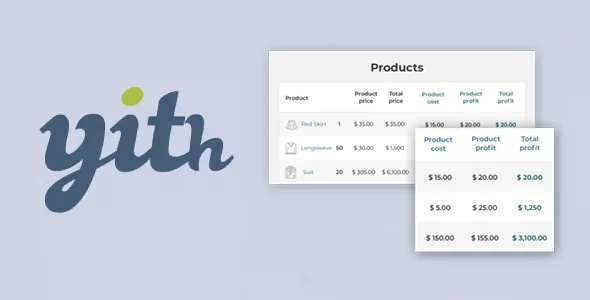
- Automatic calculation of gross profit per order: When an order is processed, the module calculates the gross profit by subtracting the total cost of the products from the order revenue. This data appears in the order view within the back office, turning each transaction into a unit of profitability analysis without any additional work from the team.
- Cost and margin columns in the order list: The WooCommerce admin panel displays status, date, and amount columns by default. This tool adds columns showing the total cost and net profit for each order, allowing you to sort and filter by profitability directly from the listing view—something that isn't possible by default in WooCommerce.
- Profit reports by period, product, and category: The reporting section has been expanded with views showing cumulative profit by date range, broken down by product or category. This allows you to identify which product lines generate the highest real margin, not just the highest sales volume—essential data for replenishment decisions and catalog management.
- Bulk import of costs using CSV: Manually updating the cost of hundreds of products is impractical when supplier prices change frequently. This plugin allows you to import costs in bulk from a CSV file, making mass updates a process of minutes instead of hours, while keeping profitability data always up-to-date.
- WooCommerce tax system compatibility: Margin calculations can be configured to operate on prices with or without taxes included, depending on how the store's accounting is structured. This flexibility prevents distortions in profitability data caused by how prices are presented in the catalog.
Who is this product for?
This plugin is especially useful for those operating WooCommerce stores with medium to large catalogs, tight margins, or high stock turnover, where the difference between an informed pricing decision and an estimate can determine whether a product line is profitable or not. It also fits well in operations where the team needs to respond quickly to supplier cost changes without losing traceability.
- Store managers and technicians who need visibility into profitability per order or SKU without relying on external tools, and who value having that data available directly in the WooCommerce back office with minimal setup effort.
- Teams that manage multiple projects or stores and need cost data to be constantly updated and consistently available across all environments, especially when catalogs share references or supplier prices change regularly.
- Marketing and category managers need to know the real margin before launching a promotion, setting up a discount coupon, or making decisions about which products to boost in campaigns, to avoid a commercial action that is successful in volume resulting in net losses.
Real-world use cases
- Fashion store with products in multiple sizes and colors: The purchasing manager needs to know if the margin for a specific product remains positive across all its variations before including it in a clearance sale. Without cost-per-variation data, this analysis requires cross-referencing three different sources. With this module active, they can open the product page, review the costs per variation, and validate in seconds whether the proposed discount leaves sufficient margin. The result: more profitable campaigns and pricing decisions based on real data.
- Distributor with a catalog of more than 500 items: The main supplier updates its pricing twice a year, and the team has to reflect those changes in WooCommerce flawlessly. Previously, this update involved editing products one by one. With this tool's bulk CSV import, the process is reduced to preparing the file with the new costs and uploading it, keeping profitability reports instantly up-to-date and without the risk of omissions.
- Electronics store with variable margins by category: The e-commerce manager notices that sales in one category are growing, but monthly profit isn't improving. With the category margin reports provided by this add-on, they can compare the actual performance of each product line and discover that a high-volume category is operating with negative margins due to a discount configuration that was never reviewed. Correcting this directly transforms the business's profitability.
- Agency that manages multiple stores for different clients: The technical team needs each store to maintain its own up-to-date cost data and for profitability reports to be available to clients without manual exports. This module is configured independently for each store, with its own catalogs and costs, and the reports integrated into WooCommerce allow each client to review their profitability directly from the dashboard without requiring technical team intervention for each inquiry.
Frequently Asked Questions about YITH WooCommerce Cost of Goods
Do I need any additional plugins besides WooCommerce for it to work properly?
The only real functional dependency is WooCommerce running on the site. Without this core, the extension has no context to operate in: no products, no orders, and no data structure on which to calculate margins. It doesn't require any additional third-party plugins to function in its base configuration, although it can be supplemented with other YITH modules if needed. It's advisable to verify that there are no customizations on the product page that could interfere with the cost fields before applying the configuration to production.
Does the end customer see anything different at checkout or in their account?
No. All the functionality of this module operates exclusively in the back office: cost fields, margin calculations, and profitability reports are internal management data that are never exposed on the front end. The checkout, product page, shopping cart, and customer area continue to display exactly the same information as without the plugin. The customer experience is not affected in any way, making the integration seamless from the end user's perspective.
Can I set up automatic rules to update margins or alerts when the cost exceeds a threshold?
The module does not include a native automated alert system based on margin thresholds, but it centralizes cost data so that any manual review or export always reflects current values. For more advanced automations—such as notifications when the margin falls below a certain percentage—this tool would need to be combined with an automation plugin or custom logic. What is natively automated is the margin calculation for each processed order, without manual intervention.
Does it affect the calculation of renewals or recurring subscriptions?
For stores that operate on a subscription basis—using WooCommerce Subscriptions or another compatible plugin—the product cost is applied to the margin calculation for each renewal order, just like any standard order. It doesn't affect the renewal process itself or interfere with billing cycles. If the product cost changes between renewals, the margin calculated for new orders will reflect the updated cost, allowing for accurate profitability tracking throughout a subscription's lifecycle.
Do the margin calculations take into account taxes, coupons, or shipping costs?
The tool allows you to configure whether calculations are based on prices including or excluding taxes, depending on the store's accounting structure. Discounts applied through coupons do affect the revenue used as the basis for calculating the margin, so the profit reflected in the reports is the actual margin after discounts. Shipping costs can be configured to be included or excluded from the calculation according to the operator's needs, providing flexibility without compromising data consistency.
How does it perform with large catalogs or during periods of high order volume?
The module does not process margin calculations at checkout and does not generate any additional load for the end customer, as all the logic is executed in the back office when querying or viewing orders and reports. In high-volume stores, performance depends primarily on the server infrastructure and how well the WooCommerce database is optimized. There are no absolute guarantees, but the extension's design avoids costly operations in the critical purchase flow, minimizing its impact on store speed.
Does it work in multisite environments or in agencies that manage multiple stores?
The extension can be deployed independently on each site within a multisite network, with its own catalogs and pricing configurations. There is no native, centralized, multi-store view within the module, so each instance manages its data autonomously. For agencies managing multiple client stores, this means each environment maintains its own cost and margin tracking, which is advantageous in terms of data isolation, although it does require accessing each dashboard separately to review reports.
How do I know that the module is working correctly once it's configured?
There are several practical indicators that confirm the integration is working as expected. When editing a product, the cost field should appear in the product data section. When reviewing a processed order, the cost and profit columns should be visible in the back-office order list. Sales reports should display margin data by period. If any of these elements are missing, review user role permissions and confirm there are no conflicts with other add-ons that modify the structure of the product card or the order panel.
Short description
It records the actual cost of each product and variation in WooCommerce, automatically calculates margins per order, and puts profitability data where you need it: directly in the back office, without external spreadsheets.

Written and reviewed by the PrimeGPL Team
At PrimeGPL, we ensure that every piece of published content is verified and reviewed by our team. We analyze features, compatibility, and performance to provide you with clear, up-to-date, and truly useful information for each product listed in our store.
Get your questions answered here
We answer your questions so you can buy in an informed and confident manner.
Does my purchase include updates?
Yes. Every product purchase includes lifetime updates, so you won't have to pay extra under any circumstances.
Is there a daily download limit?
No, not at all. After your purchase, you can download it as many times as you need, without any problem.
On how many websites can I use the products?
You can use your purchases on as many domains (websites) as you want, without any problems.
Does it include technical support?
Yes. We offer technical support Monday through Friday, during business hours UTC -3. This support includes assistance with issues related to download problems, installation problems, or errors with the purchased product.
Furthermore, support does not include configurations, customizations, tutorials, or services associated with the author.
Does my purchase have a warranty?
Yes, of course. If you have any problem that we can't solve, or if there's an external issue that doesn't have a general solution related to our service, you'll receive support and, if necessary, a full refund.
How do I access support?
After your purchase, from your user account, you can access the support section, where you can open a ticket and our team will assist you with whatever you need.
Download Previous Versions
If you have purchased this product, or have an active membership, you can download previous versions without any limits or restrictions.
| Product Name | Version | Size | Date | Download |
|---|---|---|---|---|
| No hay versiones anteriores registradas. | ||||
Related Products
Below we show you different products that share the same category.