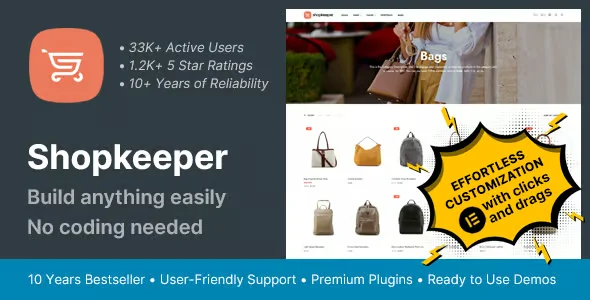
Shopkeeper eCommerce WordPress Theme
$59.00 Original price was: $59.00.$4.99Current price is: $4.99.
Shopkeeper eCommerce WordPress Theme is a visual design and architecture solution for WooCommerce stores that need to present products clearly, maintain a seamless shopping experience, and reduce the burden of manual customization. It's ideal for retailers managing medium to large catalogs who require aesthetic control without sacrificing stability or loading speed. It relies on WooCommerce as its transaction engine.
Introduction to Shopkeeper eCommerce WordPress Theme
Shopkeeper eCommerce WordPress Theme was born to solve a very specific friction in online stores: the distance between a visually coherent design and a shopping experience that doesn't break the customer flow, eliminating the need to build from scratch or depend on multiple design plugins that interfere with each other.
Technically, this theme integrates conversion-optimized page structures directly into the WordPress presentation layer, which means a simplified back office: fewer scattered shortcodes, fewer style conflicts, and template management that the administrator can control without touching code. The operational load is reduced because the theme already makes design decisions that would normally require custom development.
Imagine a store manager who receives 200 daily visits but sees a high abandonment rate on the product page. Upon migrating to this visual structure, they notice that the purchase buttons weren't prominent and the category navigation was confusing. With this theme active, those elements are already hierarchically organized by default, and the settings are applied from the customizer without editing PHP templates.
Product overview
The functional area of this plugin covers store design, user experience in catalog and checkout, and visual stability on mobile devices, three vectors that directly impact the conversion rate and brand perception in stores that aspire to scale without rewriting their frontend every season.
Before this tool, many stores operated with generic themes patched together with years of custom CSS, resulting in visual inconsistencies on mobile, slow loading times, and product pages that failed to communicate value. During the transition, the operator configures the main sections using the WordPress customizer and adjusts the color palette, typography, and element layout to avoid conflicts. Afterward, the store presents a consistent identity across all pages, from the catalog to the order confirmation.
- Without the add-on: The operator manages accumulated CSS, inconsistent templates, and a mobile experience that requires constant review with each core update.
- With the active add-on: The product, cart, and checkout pages use predefined, responsive templates that adapt automatically, reducing manual intervention in design.
- Observable result: lower abandonment rate on key pages, consistent visual identity across all devices, and reduced time spent on style corrections in the back office.
Requirements and compatibility
Before integrating this theme into a production environment, it is advisable to verify that WooCommerce is correctly configured as an active plugin, that the caching and image optimization plugins are compatible with third-party themes, and that any previous customization through child themes or additional CSS is documented for lossless migration.
- Main dependency: WooCommerce active and configured, as the theme extends its catalog, product and checkout templates with its own styles and structures.
- Relevant compatibility areas: checkout pages, shopping cart, product pages, category navigation, coupon blocks, shipping calculation, and standard payment gateways.
- Recommended testing scenario: staging environments with active page builder plugins, as some visual builders can overwrite theme templates and it is advisable to validate coexistence before going into production.
Key benefits for your operation
- Reduction of design time in launches: Many retailers spend weeks fine-tuning the visual appearance before launching a collection or season. This tool delivers ready-to-customize page structures, shortening that cycle and allowing for faster publishing without relying on a front-end developer for every change.
- Consistent mobile shopping experience: Mobile traffic represents a critical portion of most stores, and a design that breaks down on small screens leads to silent abandonment. This theme handles visual responsiveness natively, so mobile users see the same information hierarchy as on desktop, without strange rearrangements or cut-off buttons.
- Less reliance on additional design plugins: Each extra plugin is a potential source of conflict. By concentrating the visual logic within the theme itself, the developer reduces the number of active extensions and, consequently, the likelihood of incompatibilities after core updates.
- Visual control from the customizer without code: Teams without a technical background can adjust colors, fonts, section layout, and header behavior directly from the native WordPress customizer. This means fewer support tickets to the developer and more autonomy for the marketing or content team.
- Visual stability in extensive catalogs: When a store exceeds a certain number of product listings, generic themes begin to show inconsistencies in the product grids. This extension maintains layout consistency even with large catalogs, improving the perception of professionalism and facilitating customer navigation.
- Functional integration with the checkout flow: The checkout is the most critical moment in the purchase journey. This module presents that flow with a clean design, free of unnecessary distractions, and with trusted elements correctly placed, reducing friction precisely where it matters most to retain the customer.
Highlighted Features of Shopkeeper eCommerce WordPress Theme
- Native, conversion-oriented responsive design: The product and catalog templates are built with a visual hierarchy that guides the customer toward the purchase action, adapting to any screen size without requiring additional adjustments. In a store with high mobile traffic, this prevents the design from being the reason the customer abandons the item before adding it to their cart.
- Integrated visual customizer with advanced options: Beyond basic WordPress settings, this theme offers granular visual configuration options such as header styles, menu behavior, product card layout, and color schemes per section. The team can iterate on the design without touching template files.
- Optimized product page templates: The product page includes clearly defined sections for gallery, description, variations, ratings, and calls to action, with a structure that the operator can rearrange according to the logic of their catalog. This is especially useful in stores with complex or configurable products where information must be presented clearly.
- Compatibility with WooCommerce Blocks and classic widgets: The tool supports both Gutenberg's block editor and traditional widgets, allowing stores with mixed architectures to work without forcing a complete migration to one system or the other. This reduces operational risk when updating or expanding content.
- Configurable typography system and palette: Brand identity impacts customer trust. This plugin allows you to define Google Fonts typefaces and global color palettes from the customizer, ensuring that every element of the store adheres to that central configuration without inconsistencies between pages.
- Support for mega menus and complex category navigation: In catalogs with multiple category levels, navigation becomes a UX problem if the theme doesn't handle it properly. This extension includes mega menu capabilities that allow you to display subcategories, category images, and featured links in a single dropdown, making it easier for customers to find what they're looking for without relying on the internal search engine.
Who is this product for?
This topic is especially valuable for retailers who already have a functioning store but feel that the current design is hindering conversions, doesn't accurately reflect the brand, or generates too much visual maintenance work. It also fits with those launching a new store who want to start from a solid foundation without incurring the cost of a completely custom design.
- Administrators or technicians who need to control the visual presentation of the store with traceability, without relying on scattered code or patched solutions that break with each update.
- Teams that manage multiple projects or stores and need a theme that offers operational consistency: once the configuration is mastered, it can be replicated and adapted to new projects with a shorter learning curve.
- Marketing or UX managers who depend on the customer's visual experience being aligned with active campaigns, and who need to be able to adjust the design quickly without creating bottlenecks in the technical team.
Real-world use cases
- Fashion store with seasonal collections: A clothing store was launching new collections every season and needed to update the design of its homepage and category pages without hiring additional development staff. With this live theme, the marketing team could configure featured sections from the customizer, upload campaign images, and adjust the seasonal color palette in less than a day. The result: faster launches and a cohesive presentation that reinforces the collection's identity.
- Electronics store with an extensive catalog: A store with over a thousand product listings was experiencing visual inconsistencies in its product grid when items with images of varying aspect ratios were displayed side-by-side. By migrating to this theme, the catalog templates standardize image presentation and maintain grid consistency regardless of the original format. Customers navigate the catalog more smoothly, and the administrator no longer receives reports of broken displays.
- Agency that manages several client stores: An agency team needed a base theme that could be adapted to different brand identities without rewriting templates from scratch for each project. With this module's customizer, they create a child theme for each client and apply each brand's specific color palette, typography, and layout. Project turnaround time is significantly reduced, and the maintenance base is consistent across all projects.
- Growing store with a focus on mobile: A wellness product store discovered that over 60% of its traffic came from mobile devices, but the conversion rate on those devices was significantly lower than on desktop. After adopting this theme, the mobile experience on the product page and checkout improved noticeably: the purchase buttons are easily accessible, the gallery is responsive to touch, and the checkout process doesn't require users to zoom. The difference in conversion rates between devices visibly decreased in the following weeks.
Frequently Asked Questions about the Shopkeeper eCommerce WordPress Theme
Which plugins and tools is this theme compatible with?
This theme is designed to work with WooCommerce as its core dependency, and its compatibility extends to the most common plugins in the ecosystem: standard payment gateways, shipping plugins, coupon managers, and product rating tools. Before integrating it into a production environment, it's advisable to verify compatibility with any existing page builder or caching plugins, as some of these may interfere with the theme's templates. Testing in a staging environment resolves this issue before it impacts live traffic.
How does it improve the customer experience in the buying process?
The most direct impact is felt on product pages and at checkout. This theme presents these moments with a clear visual hierarchy: calls to action are in easily accessible positions, trust elements such as reviews and return policies appear near the purchase button, and the checkout flow is uncluttered. For the end customer, this translates into fewer doubts during the purchase and a perception of greater professionalism, reducing abandonment at the most critical point in the customer journey.
Does this theme allow you to configure visual rules or automatic conditions based on product type or category?
The theme itself manages the visual presentation and doesn't run business automations like pricing rules or stock conditions. However, its template architecture allows WooCommerce automation and rules management plugins to integrate seamlessly, as it respects the ecosystem's standard hooks. If you need to display different layouts by category, combining this theme with a conditional template plugin covers that scenario without any known conflicts in properly configured environments.
Does this affect recurring payments or subscription management in any way?
This theme operates at the presentation layer and does not interfere with WooCommerce's transactional logic. Recurring payment flows, automatic renewals, and subscription management depend entirely on the plugin that handles them, such as WooCommerce Subscriptions. However, it can improve the visual experience on account management and renewal pages, presenting this information more clearly to the customer. Before assuming full compatibility with specific subscription plugins, it's worth testing in a staging environment.
How does it interact with the shipping, tax, and coupon modules?
This plugin does not modify the logic for calculating shipping, taxes, or coupons: those functions remain under the control of WooCommerce and its associated extensions. What the theme provides is a clearer visual presentation of this information during checkout, so the customer understands the costs before confirming the order. This reduces customer service inquiries about unexpected charges and improves confidence at the point of payment.
How does the store perform under high traffic volumes or very large catalogs?
Performance under load depends on multiple factors beyond the theme itself: hosting, caching, image optimization, and server configuration. That said, this theme is built with clean code and no unnecessary heavyweight script dependencies, contributing to reasonable load times when the environment is properly configured. In large catalogs, visual consistency is maintained without noticeable degradation, although it's always advisable to complement it with a caching and image optimization strategy to ensure stability during traffic spikes.
Is it viable to use this theme in multisite installations or to manage multiple stores?
The theme can be used in WordPress multisite environments, although centralized style management across sites requires prior planning. The most common strategy in agencies is to create a child theme for each client or store, using the main theme as a base, and apply project-specific customizations to that layer. This allows for maintaining a common, updatable foundation without losing the individual configurations of each store. For large-scale multistore operations, it's advisable to thoroughly document the structure before scaling.
How can I verify that the theme is working correctly in my store?
A practical checklist includes: verifying that the product, cart, and checkout pages load with the expected design on mobile and desktop; checking that the customizer options are reflected in real time without console errors; verifying that the WooCommerce blocks on the homepage or catalog render correctly alongside the active theme; and confirming that key plugins such as the payment gateway and shipping manager continue to operate without error messages in the back office. If all of these are functioning normally, the theme is correctly integrated into your environment.
Short description
WordPress theme designed for WooCommerce stores that need a consistent visual experience, a frictionless checkout, and design control from the customizer, without relying on custom code or additional design plugins.

Written and reviewed by the PrimeGPL Team
At PrimeGPL, we ensure that every piece of published content is verified and reviewed by our team. We analyze features, compatibility, and performance to provide you with clear, up-to-date, and truly useful information for each product listed in our store.
Get your questions answered here
We answer your questions so you can buy in an informed and confident manner.
Does my purchase include updates?
Yes. Every product purchase includes lifetime updates, so you won't have to pay extra under any circumstances.
Is there a daily download limit?
No, not at all. After your purchase, you can download it as many times as you need, without any problem.
On how many websites can I use the products?
You can use your purchases on as many domains (websites) as you want, without any problems.
Does it include technical support?
Yes. We offer technical support Monday through Friday, during business hours UTC -3. This support includes assistance with issues related to download problems, installation problems, or errors with the purchased product.
Furthermore, support does not include configurations, customizations, tutorials, or services associated with the author.
Does my purchase have a warranty?
Yes, of course. If you have any problem that we can't solve, or if there's an external issue that doesn't have a general solution related to our service, you'll receive support and, if necessary, a full refund.
How do I access support?
After your purchase, from your user account, you can access the support section, where you can open a ticket and our team will assist you with whatever you need.
Download Previous Versions
If you have purchased this product, or have an active membership, you can download previous versions without any limits or restrictions.
| Product Name | Version | Size | Date | Download |
|---|---|---|---|---|
| No hay versiones anteriores registradas. | ||||
Related Products
Below we show you different products that share the same category.