FamiPress Genealogy and Family Tree Theme
$29.00 Original price was: $29.00.$4.99Current price is: $4.99.
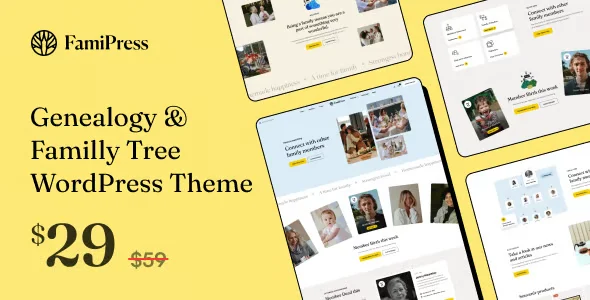
FamiPress Genealogy and Family Tree Theme is a WordPress theme designed to build genealogy and family tree websites with a structured, fluid, and professional visual presentation. Ideal for projects that require displaying complex family relationships, this plugin eliminates the need for makeshift solutions and offers a solid technical foundation integrated with the WordPress ecosystem.
Introduction to FamiPress Genealogy and Family Tree Theme
When a WordPress project needs to display family trees in a coherent, navigable, and visually appealing way, the absence of a proper theme structure creates chaos in data presentation, inconsistencies in family hierarchy, and a user experience that frustrates before it engages—FamiPress Genealogy and Family Tree Theme solves exactly that friction from the theme layer.
The tool operates as a parent theme or visual base, integrating genealogical data structures directly into the template without relying on generic solutions that require constant overwriting. This reduces the back-office maintenance burden and minimizes presentation errors as the volume of family profiles grows.
An administrator managing a family history portal can, from the WordPress panel, organize profiles, relationships, and generations with a presentation logic already resolved by the theme — without touching code, without visual patches, without mobile crashes when a user consults their tree from their phone.
Product overview
In WordPress genealogy projects, the visual management of family relationships directly impacts site credibility, user retention, and content scalability — and a theme that wasn't designed for this purpose turns every update into a manual task that accumulates technical debt.
Before incorporating this module, teams typically combined generic themes with scattered shortcodes, visually inconsistent widgets, and page structures that collapsed after adding more than three generations. The visitor experience was confusing, and the operator wasted hours adjusting layouts that should have been automatic.
- Without the add-on: Each family tree required manual configuration of layouts, individual profiles lacked a clear visual hierarchy, and relationships between members were displayed without contextual navigation, forcing the user to get lost among disconnected pages.
- With the active add-on: The theme automatically applies specific visual structures to genealogical profiles, connects family relationships with integrated navigation, and presents generations with a hierarchy readable from any device.
- Observable result: The visitor navigates the family tree seamlessly, the administrator adds new profiles without manual design adjustments, and visual consistency is maintained even as the project scales to hundreds of records.
Requirements and compatibility
Before deploying this tool in a production environment, it is advisable to verify that the WordPress site is correctly configured for third-party themes, that there are no conflicts with active child themes, and that the genealogy or family profile management plugins already operating on the site are compatible with the template structure that this theme uses.
- Primary dependency: WordPress as the base CMS, with the ability to manage custom content types and relationships between posts — standard functionality in well-configured installations.
- Relevant compatibility areas: profile presentation, hierarchical navigation, genealogical shortcodes, family tree widgets, integration with biographical data plugins, and compatibility with visual page builders if used in parallel.
- It is advisable to conduct tests in a staging environment when the site already has an active theme with extensive customizations, to verify that the visual migration does not break existing content structures before publishing the changes.
Key benefits for your operation
- Eliminating visual friction in profile management: Maintaining design consistency on a genealogy website with constantly growing records is a burden that generic themes cannot handle. This module automatically applies the correct structure to each profile type, reducing manual review time and presentation errors that appear when scaling.
- Contextual navigation that retains users: When a visitor can't intuitively follow the family history, they leave. The extension builds navigation paths between generations and relationships that guide the user without the operator having to configure additional menus or manual links between pages.
- Responsive adaptability without technical intervention: Genealogy projects receive mostly mobile traffic, and a design that breaks down on small screens destroys the project's credibility. This tool manages the adaptive display of trees and profiles without requiring additional CSS or device-specific adjustments.
- Reduction of technical debt in upgrades: As the WordPress ecosystem evolves, ad-hoc themes accumulate incompatibilities. This plugin, being specifically designed for genealogical use cases, reduces the surface of conflicts and minimizes the impact of environment updates on the site's presentation logic.
- Editorial control from the back office without technical knowledge: The team managing genealogical content can add, edit, and reorganize family members from the WordPress dashboard with predictable visual results, without requiring developer intervention for each structure or relationship change.
- Scalability without UX degradation: When a project grows from fifty to five hundred profiles, the pressure on design is enormous. This tool maintains visual consistency and navigability regardless of the volume of content, protecting the end-user experience as the project matures.
Featured Features of FamiPress Genealogy and Family Tree Theme
- Specific templates for genealogical profiles: The theme includes layouts designed exclusively to display biographical information, birth and death dates, and family relationships with a clear visual hierarchy — something a generic theme will never be able to do without constant manual overwriting.
- Structured visualization of relationships between generations: The tool presents parent-child, spouse, and side branch connections with a visual logic that the visitor immediately understands, eliminating the need for additional legends or explanations that interrupt the tree exploration.
- Native integration with the genealogy plugin ecosystem: This plugin is designed to work alongside the most common familiar WordPress data management plugins, meaning that data already captured in the system is presented without the need to reformat or duplicate content.
- Typography system and palette optimized for reading historical data: Genealogical projects often involve dense text, dates, places, and compound names. This theme employs a typographic hierarchy that facilitates quick reading of key data without visually cluttering the page.
- Compatibility with visual builders: When the team needs to customize specific sections of the site without touching the theme code, the extension allows integration with major page builders, maintaining consistency with the base genealogy templates.
- Customization options from the WordPress Customizer: Colors, fonts, element layout, and presentation settings are managed from the native WordPress customization panel, without the need for additional files or development knowledge to adapt the theme to the project's identity.
Who is this product for?
This module is especially valuable for those managing genealogy projects on WordPress with a growing number of profiles and who need a professional visual foundation that doesn't require constant technical intervention to maintain consistency. If the project already has data but lacks a presentation layer, this tool fills that gap perfectly.
- Administrators and technicians who need control over the presentation of complex family relationships without relying on developers for every visual or structural adjustment.
- Teams that manage multiple genealogical projects or family history portals and need a consistent thematic foundation that can be replicated without configuration from scratch in each new project.
- UX or content managers in organizations that publish historical archives, digitized civil records, or family memory projects, where the end-user experience is as important as the accuracy of the data.
Real-world use cases
- Family history portal with rapidly growing records: An organization that digitizes historical archives needs to publish hundreds of genealogical profiles every week. Without a specific theme, each profile requires manual layout adjustments. With this plugin, the editorial team adds records directly from the back office, and the theme automatically applies the correct visual structure—the result is a portal that scales seamlessly.
- Community genealogy project with multiple collaborators: When multiple editors contribute profiles to the same site, visual inconsistency is inevitable if the theme doesn't enforce a fixed structure. This tool acts as a standardization layer, ensuring that every published profile, regardless of who created it, is presented with the same hierarchy and visual consistency.
- Migration from a generic solution to a real genealogical platform: An administrator who has spent years patching a multipurpose theme to display family trees decides to migrate. With this module, the transition involves activating the theme and mapping existing content types to specific templates—reducing migration time and eliminating accumulated technical debt.
- Family archive site with mobile access: A family that maintains records across multiple generations receives most of its visits from mobile phones during meetings and events. The theme's responsive design ensures that any member can view relationships and profiles from their device without any design breaks or the need to manually zoom in to read key information.
Frequently Asked Questions about FamiPress Genealogy and Family Tree Theme
Does it work with any WordPress installation or does it require specific prior configuration?
The theme requires a WordPress installation with support for custom post types and the ability to manage post relationships—standard setup in most well-maintained environments. It's advisable to verify that there are no conflicts with active child themes or template customizations that might interfere with the theme's presentation logic. A preliminary review of your environment before activation is usually sufficient to identify any potential issues.
How does this issue affect the experience of a visitor browsing a family tree?
The difference is immediate: visitors find structured navigation between profiles and generations, without needing back buttons or manual searches to follow a familiar path. The theme builds contextual navigation routes that guide exploration naturally, reducing the abandonment that occurs when the tree is presented as a flat list of pages without visual hierarchy.
Can I apply conditional rules or show different content depending on the type of family relationship?
The tool includes separate templates for different relationship types—parents, spouses, extended family—allowing the system to automatically apply the correct display based on the profile data. For more advanced conditions based on user roles or content access levels, additional visibility control plugins may be required.
Does this issue have any impact on payment flows or subscriptions if the site has WooCommerce enabled?
Since this is a genealogy presentation theme, its direct impact on the WooCommerce checkout is neutral—it doesn't modify payment flows or cart logic. However, if the site sells access to genealogical records or memberships, it's advisable to verify that the WooCommerce checkout and user account templates don't conflict with the theme's base templates, especially on pages that share both functionalities.
How does the issue of data presentation work in projects with multiple family branches and hundreds of profiles?
The theme design prioritizes scalability: profile templates and navigation structures maintain visual consistency regardless of record volume. However, loading performance in very large projects also depends on server infrastructure and how well genealogical data is optimized in the database—factors external to the theme but relevant to the overall user experience.
Is site performance affected when there are many active profiles simultaneously?
The theme itself doesn't introduce significant additional load on the server beyond any other well-coded WordPress theme. Low-volume performance depends primarily on the quality of the hosting, an active caching system, and how database queries from genealogy data plugins are structured. With adequate infrastructure and a configured cache, the theme responds smoothly even with extensive profile catalogs.
Can this theme be used in a multisite installation or to manage multiple genealogy projects from a single WordPress site?
WordPress multisite compatibility is technically possible for many standard themes, but it's advisable to verify that the theme's templates and styles are applied correctly to each subsite in the network without interference between projects. In complex multisite setups with site-specific customizations, staging verification before deploying to production prevents visual inconsistencies between different managed projects.
How can I verify that the theme is working correctly after activating it?
A practical check includes: verifying that genealogy profiles are displayed using the theme's specific template and not the generic input template; navigating between related profiles and confirming that the relationship links work correctly; reviewing the mobile display to validate responsive behavior; and confirming from the Customizer that color and typography settings are reflected in real time without caching errors. If all these points are successful, the theme is operational.
Short description
A WordPress theme specializing in genealogy that transforms family tree management into a structured, scalable, and navigable visual experience — without technical friction for the operator or confusion for the visitor.

Written and reviewed by the PrimeGPL Team
At PrimeGPL, we ensure that every piece of published content is verified and reviewed by our team. We analyze features, compatibility, and performance to provide you with clear, up-to-date, and truly useful information for each product listed in our store.
Get your questions answered here
We answer your questions so you can buy in an informed and confident manner.
Does my purchase include updates?
Yes. Every product purchase includes lifetime updates, so you won't have to pay extra under any circumstances.
Is there a daily download limit?
No, not at all. After your purchase, you can download it as many times as you need, without any problem.
On how many websites can I use the products?
You can use your purchases on as many domains (websites) as you want, without any problems.
Does it include technical support?
Yes. We offer technical support Monday through Friday, during business hours UTC -3. This support includes assistance with issues related to download problems, installation problems, or errors with the purchased product.
Furthermore, support does not include configurations, customizations, tutorials, or services associated with the author.
Does my purchase have a warranty?
Yes, of course. If you have any problem that we can't solve, or if there's an external issue that doesn't have a general solution related to our service, you'll receive support and, if necessary, a full refund.
How do I access support?
After your purchase, from your user account, you can access the support section, where you can open a ticket and our team will assist you with whatever you need.
Download Previous Versions
If you have purchased this product, or have an active membership, you can download previous versions without any limits or restrictions.
| Product Name | Version | Size | Date | Download |
|---|---|---|---|---|
| No hay versiones anteriores registradas. | ||||
Related Products
Below we show you different products that share the same category.